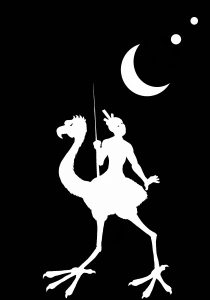
During a pitched battle against the Taniwha, a small taua (war-party) of Aho, led by Nukutawhiti, suffered defeat. Being the only survivor, Nukutawhiti was forced to flee, having been blinded in the chaos. Ravaged from terrible body wounds and alone, Nukutawhiti pleaded to the gods for mercy, and they responded by sending a messenger in the form of the song-bird, Tūī.
The tūī descended from the trees and attracted Nukutawhiti to follow, but as the warrior was without sight and struggling to keep up, the bird landed on an overhanging branch and chirped madly until Nukutawhiti finally understood, reaching up and snapping down the branch to use as a tokotoko (walking stick).
Nukutawhiti slowly followed the tūī for much of the day, and the winged guide eventually brought the Aho to a small isolated clearing, where the sound of hissing steam escaping the ground filled his ears. Nukutawhiti immediately recognised the life-giving properties of Papatūānuku (Mother Earth), and approached without fear.
The wee crack in the hardened surface through which the mana (energy) seeped was not enough to soothe his wounds, so the Aho charged his tokotoko, raised it above his head and drove it deep into the ground, causing the area to give way to a small pool of naturally warmed water – the powerful healing essence of the Earth. Nukutawhiti did not hesitate to enter the magic waters and it soon restored the man back to health.
Though the waters were not powerful enough to restore his vision, the Aho blessed the site and honoured his feathered friend by sharing his wairua (spirit) with the tūī and, trusting the eyes of the bird as his very own, the pair never separated again.
These sacred pools remain in the Far North to this day and are still used for healing.
 Māori Magic and Mythology